

View:
1.0x
Identity area
Reference code
SHM-SMUTS-1950-P01
Title
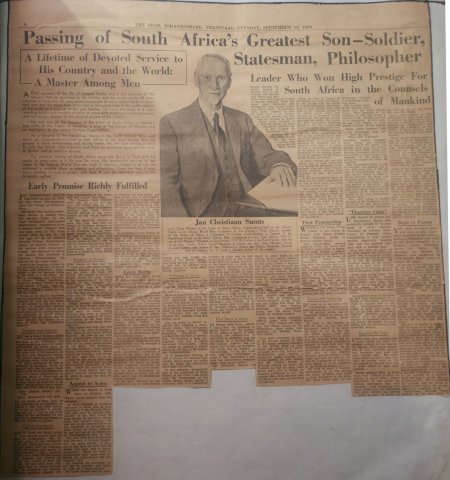
Scrapbook page 1: Passing of South Africa's Greatest Son - Soldier
Date(s)
- Tuesday 12 September 1950 (printed dateline) (Creation)
Level of description
Item
Extent and medium
1 scrapbook page
Context area
Name of creator(s)
Repository
Content and structure area
Scope and content
Quality check: on 4 part(s) of this page with enough text, 89% of the words in the shorter of two independent model reads are confirmed word for word by the other read.
THE STAR, JOHANNESBURG, TRANSVAAL, TUESDAY, SEPTEMBER 12, 1950
Passing of South Africa's Greatest Son - Soldier,
Statesman, Philosopher
A Lifetime of Devoted Service to
His Country and the World:
- A Master Among Men -
Early Promise Richly Fulfilled
Support of Kruger
Louis Botha
Appeal to Arms
Call to the North
4
THE STAR, JOHANNESBURG, TRANSV
Passing of South Africa
A Lifetime of Devoted Service to
His Country and the World:
- A Master Among Men -
A FULL account of the life of General Smuts, and a just estimate of the services that he rendered to his country and the world, would fill many volumes. In more than 50 years among his people he was a valiant leader in peace and war; and for more than 30 he held an honoured place in the public opinion of the world as a political thinker and teacher. He owed this place to a commanding height and breadth of vision, to great gifts of advocacy and persuasion, and not in any degree to the physical powers of his country.
He was one of the founders of the Union of South Africa; a signatory and critic of the Treaty of Versailles; a pillar of the League of Nations; and an inspiration to the United Nations Organisation.
As a General in the Republican Forces in the South African War, and again as Commander-in-Chief in East Africa in the First World War, he proved a hard, enterprising and daring leader. He left East Africa in 1917 to join the British War Cabinet, and there he rendered signal services both in Britain and in missions abroad.
The political history of South Africa since the Union is filled with his name. In great part it is his own life story. His inestimable services to the Union in the Second World War are fresh in memory. Added to all this, he achieved a notable place in science and philosophy. There are few, if any, exact parallels to such a career; and here it can be recorded only in, the broadest outline.
Early Promise Richly Fulfilled
JAN CHRISTIAAN SMUTS was born on May 24, 1870, on the farm Bovenplaats, near the village of Riebeek West.
His father was Jacobus Abraham Smuts, a farmer who for several years in the Cape Parliament represented Malmesbury. Considered to be a delicate child "Jannie" was not sent even to the local school until he was 12. At the age of 15 he entered Victoria College, Stellenbosch, where he applied himself to his studies with remarkable
Boer particularism of the Transvaal and Orange Free State.
The Jameson Raid, however, drove him (as it did Jan Hofmeyr and others) into the anti-Rhodes camp, whence he delivered speeches and wrote articles warning Britain of the consequences of any but a moderate policy.
In this mood he decided to leave the Cape and seek his fortune in President Kruger's republic. In 1896 he was admitted to the Transvaal Bar and established himself in Johannesburg. He had no practice, but great faith in himself. So despite limited means, on May 1, 1897, he married Sybilla Margaretha Krige, who had been a fellow student at
of restoring his own people, and soon became one of their leaders. He was appointed spokesman of the deputation which met Joseph Chamberlain in Pretoria in 1903. He helped to draw the Afrikaners together in a political party named Het Volk, and after the victory of the Liberal Party in England in 1905 he hurried to London to discuss self-government. He influenced the drafting of the Constitution for the Transvaal, and its liberality deeply impressed him.
In preparing for the election of the Transvaal Legislature, he went back to his pre-Jameson Raid attitude and preached the union of the two races. He declared that the flag had been decided for ever,
Jan Christ
twice Prime Minister of the Union of South Africa; a member of His Majesty's Government in Great Britain during the Second World War; a member of the Order of Merit; a Companion of the Bath; a General Officer Commanding Republican Forces in the South African War; one of His Majesty's Ministers in Great Britain during the First World War; Knight Commander of the Most Honourable Order of the Bath; King's Counsel; Fellow of the Royal Society;
TRANSVAAL, TUESDAY, SEPTEMBER 12, 1950
ica's Greatest Son-Soldier,
Statesman, Philosopher
Leader Who Won High Prestige For
South Africa in the Counsels
of Mankind
General Hertzog. He openly sneered at Botha's policy of conciliation and asserted that Briton and Afrikaner were races destined to keep in separate channels. From this gospel came Botha-ites and Hertzog-ites, who drifted further and further apart. In December 1912. Botha resigned so that he could form a new Cabinet and exclude Hertzog, who had been his Minister of Justice. Smuts made attempts to heal the breach, but Hertzog proved obdurate and in 1914 founded the Nationalist Party.
Troubles did not come singly. In July, 1913, and again in January, 1914 strikes on the Rand spread
When he went to London in 1917 Smuts was fairly well-known. He left Europe with the status of a world statesman. His clearness of mind, driving force, and faith in the eventual success of the Allied cause made him welcome to a depressed British Government. His speeches greatly impressed the public. He became the only permanent Dominion member of the War Cabinet, and undertook highly important work including secret missions abroad.
At the Peace Conference in 1919 he was a notable figure, and one of the signatories of the Versailles Treaty. In a famous memorandum he explained why he disagreed with some of its terms. He was a prominent protagonist of the League of Nations, and his conception of the political character of the post-war British Empire found general acceptance.
In short, between 1917 and 1919 Smuts won a world reputation as a far-sighted statesman, whose opinions deserved deep respect. Several positions overseas were suggested for him. He refused them all.
Of the six months he spent in Paris for the peace negotiations he said in later years that they "for ever changed me."
"The misery of the Boer War was nothing to the misery of this war. It was a break in one's own life, but not in the whole world. Paris showed me the crack in life itself. It broke me. It changed me. I am a softer man than I used to be. Whether for better or worse I don't know. I was hard as a young man - hard and confident and successful."
Nationalists declined to abandon the republican ideal. The deadlock ended in the Unionist Party fusing with the South African Party. They appealed to the electorate in 1921 and gained a majority of 24. Hertzog appeared to be vanquished. In nine years he had been beaten in three general elections. He was aged 58.
Smuts found, however, that Oft expectation fails, and most oft there Where most it promises.
Depression created unemployment. Social and economic troubles roused the people. Industrial unrest swept the country. On the Rand, 23,000 troops, with bombing aeroplanes and artillery, were called to defeat Strike Commandoes. In this conflict 200 people were killed and nearly 300 wounded.
The Government began to lose by-elections. Its majority fell to ten. And when early in 1924 the seat at Wakkerstroom was lost, after special efforts to retain it, Smuts informed the House that he would appeal to the country.
The election was fought at the very bedrock of the ship. The Nationalists, in association with the polls with Labour, came back with a majority of 28. Smuts was defeated in his own constituency, Pretoria West.
Thus after being a Cabinet Minister in the Transvaal and the Union for 17 years, Smuts found himself Leader of the Opposition.
"Hopeless Odds"
LIKE Disraeli in similar circumstances, Smuts presented the picture of "a man equal to every fortune, unshaken by reverses, indifferent to personal abuse, maintaining a long combat against apparently hopeless odds with the sharpness and vigour of youth."
gap between the two big forces had been demolished.
Some former causes of deep differences had been swept away. A national flag had come to stay, and won a universal regard. The Statute of Westminster had created a sovereignty of the Union. A broad national spirit was drawing the two white races together.
When General Hertzog returned from the Imperial Conference of 1929 he made a powerful appeal for national unity, and at the same time mobilised the Republicans in his own ranks. Virtually all leading Nationalists declared that secession had become unnecessary, for the Union possessed full freedom, and associations with the Commonwealth was an advantage.
Much of the difference between the Smuts and Hertzog schools of thought had been over pace of achievement rather than objectives. The caucus party held that the Nationalists, in Hertzog's words, had been "guilty of the clumsy impudence of demanding from the present what the future will bring without effort."
So in the party fight after 1929 there was much movement but little progress. Taking advantage of this lull Smuts went to England to preside at the centenary meeting of the British Association for the Advancement of Science, and visited the United States and Canada. Everywhere he was most warmly welcomed.
Christiaan Smuts
Union of South Africa; Commander-in-Chief of the Union's d War; a member of His Majesty's Privy Council; member a Companion of Honour; Field-Marshal; a General of the uth African War; Commander-in-Chief, East Africa, 1916-17; in Great Britain, 1917-19; Fellow of the Royal Society; Bencher Counsel; Freeman of London and other cities; Honorary Doctor
First Premiership
WITHIN a few weeks of his return to the Union in August, 1919, Smuts became Prime Minister, owing to Botha's sudden death.
The Premiership seemed
Steps to Fusion
YET, while old issues faded, new ones of vital importance appeared on the horizon. Economic depression over most of the world mounted to a
not sent even to the local school until he was 12. At the age of 16 he entered Victoria College, Stellenbosch, where he applied himself to his studies with remarkable energy. He displayed no liking for games but revealed a vigorous determination to succeed in the class room.
Even in his teens his attitude to life was that of the man in one of Fletcher and Beaumont's plays: "Either I am the foremost horse in the team, or I am none." He won a scholarship that took him to Christ's College, Cambridge, where he devoted himself to his legal studies with the same unswerving concentration. His essay has earned a double first in his law tripos.
Young as he was he impressed his contemporaries by his immense capacity for work and his ability to get quickly to the root of a matter. A distinguished member of the English Bar, who in later years discussed the leading men of the profession in South Africa, remarked "Ah, the others may be good lawyers, but Smuts is a man of really fine intellectual capacity."
Student and Inquirer
HE was a lonely student, taking no part in the social or athletic activities of the University. Intensely ambitious, naturally rather self-centred, he would spare no time for small talk or amusement. His whole way of life seemed to be modelled upon Bismarck's saying, "To youth I have but three words of counsel - work, work, work."
So there developed in him a tendency to aloofness, which remained with him for many years. Never could he be half-fellow-well-mer with casual acquaintances. In his long walks at Cambridge, as in his veld and mountain rambles in later years, he preferred to be alone. In his earlier days it might have been truly said of him that:
Upon himself, himself did feed
Quiet, dispassionate and cold.
On his return to Cape Town he was admitted as an advocate on August 1, 1895, and while waiting for briefs he dabbled in journalism, sat for a time in the Press gallery of the Parliament he one day was to dominate, and began to take an interest in politics.
Call to the North
SMUTS found that South Africa had changed greatly since his days at Stellenbosch. The immense extent of the Witwatersrand gold fields had been proved beyond doubt, and the economic centre of gravity had moved to Johannesburg. The growing wealth and power of the Transvaal Republic had revived the earlier race rivalry of Boer and Briton. He had come back with a vague idea of nation-building, and he supported the Rhodes-Hofmeyr realisation against the public. In 1896 he was admitted to the Transvaal Bar and established himself in Johannesburg.
He had no practice, but great faith in himself. So despite limited means, on May 1, 1897, he married Sybilla Margaretha Krige, who had been a fellow student at Stellenbosch, and they settled down in a house in Twist Street, Johannesburg.
Support of Kruger
THE Smuts of that day was lean, pale and rather hungry-looking; wrapped up in his work and his home. He made few friends. His support of President Kruger during the crisis caused by the resignation of the Chief Justice of the Republic, Mr. John Wolmarans van der Walt, led to some feeling spurred by most of his fellows in the Common Room. Indeed The Star once was moved to write that he "was not particularly popular with his learned colleagues."
Smuts warmly defended the policy of Paul Kruger, and when the old President decided to give more posts to young South Africans, and fewer to imported Hollanders, he made F. W. Reitz, ex-President of the Free State, State-Secretary, and Smuts State-Attorney.
Thus Smuts was only just over 26 years of age when he became a high officer of the South African Republic. He took up the work with characteristic masterfulness. One of his first activities was to clean up the police administration on the Rand. The Uitlanders, who had expected a more tolerant regime, were disappointed. Smuts backed the President with energy and skill. Oom Paul was so impressed by his energy and tenacity that he took him to the Bloemfontein Conference of May 1899. There the youthful State-Attorney faced Milner, and suggested masterly compromises, but he failed to check the drift towards war.
Appeal to Arms
WHEN the appeal to arms came in October, 1899, Smuts threw himself into the struggle.
As chief organiser of Joubert's campaign in Natal then as joint commander in the Western Transvaal, and later as supreme commander of the Boer forces in Cape Colony, he had many adventures and narrow escapes. He was one of the representatives of the Republics in preparing the draft Treaty of Peace, although he was not one of its signatories at Vereeniging on May 31, 1902.
The war, from which he emerged with the rank of General, brought him one great benefit. A hard life in the open air filled out his frame, and gave him a robust appearance. When he went to Stellenbosch after peace was declared, his father-in-law did not recognise him.
He resumed his profession at the Bar in Pretoria, and began to build up a large practice. He threw himself into the work and its decorum deeply impressed him.
In preparing for the election of the Transvaal Legislature, he went back to his pre-Jameson Raid attitude and preached the union of the two races. He declared that the flag had been decided for ever, and offered British citizens the hand of friendship. He promised that he would do what he could for ex-Republican officials "without kicking the English officials out of the country." Thus early he appealed for a broad South African nationalism.
Louis Botha
THE Het Volk party which Smuts had done much to build, won the Transvaal general election in 1907 by a large majority.
Smuts entered Botha's Cabinet as Colonial Secretary, and immediately was recognised as its most powerful member. His Education Act merged into the Government system the 200 Christian National Education Schools which had been set up (with his approval) in opposition to the State schools. This policy was more conciliatory than General Hertzog's in the Orange River Colony. The handling of this subject at the same time in neighbouring colonies by these two men revealed the beginnings of fundamental differences between them.
Smuts had opposed the importation of Chinese labour for the gold mines in 1905, and he arranged a gradual repatriation.
He called out Imperial troops to quell disturbances attending a strike on the Rand; and in the absence of constitutional authority for such a step he created his own precedent. He fought the Indian passive resistance movement led by Mr. Gandhi; and when eventually he made concessions, he justified them by saying that the best policy was to acknowledge proved mistakes.
In the main, however, he was conciliatory; and the many British twice Prime Minister of the Union of South Africa in the Second World War; a member of the Order of Merit; a Companion of the Distinguished Service Order; one of His Majesty's Ministers in Great Britain; Knight Grand Cross of the Order of the Bath; King's Counsel; Fellow of the Royal Society of Literature; Doctor of Law, Letters and Science of many Universities; for 50 years citizens who had viewed the advent of the Botha Government with anxiety were relieved to find him. In common with Botha, anxious to bring about friendly relations.
Advance to Union
SMUTS was moving back to his first nation-making ideal, beginning, indeed, to talk about a unified South Africa "as far as the Zambezi."
He threw himself into the Closer Union movement, set going by Lord Selborne's memorandum entitled "The Mutual Relations of the South African Colonies." This was published following a deadlock which in 1906 developed between the Transvaal and the coast Colonies over customs duties and railway rates.
Like the group of Milner ex-officials who compiled a monumental volume, "The Government of South Africa," Smuts studied precedents everywhere and arranged the collection of information. He favoured a large geographical unit and a highly centralised Government. From the outset he opposed a federal system on the lines of the Australian Commonwealth.
At a preparatory meeting in 1908 to arrange the National Convention, Smuts moved the resolution by which the Convention itself came into being.
In this assembly, dramatically akin to the gatherings at Philadelphia in the 1770's, from which arose the Constitution of the United States, Smuts played a prominent part. It is unhistorical, however, to trace anything to the generosity of Sir Henry Campbell-Bannerman or such crucial offers as J. X. Merriman had the grip of distinguished statesmanship exercised such things Steyn and The Institute of South Africa gave Smuts a stead of being a politician; he became a statesman. When united nation was realised, events, the Union troubled period First Steps
IN Botha's first Cabinet Smuts held Mines, Defence and Labour. He set himself to including the difficulties in the foundation of The Cabinet. happy, and as 1911 Smuts to Bloemfontein, how long it going to last, pens that Gov sooner than p The distu
Union of South Africa; Commander-in-Chief of the Union's d War; a member of His Majesty's Privy Council; member a Companion of Honour; Field-Marshal; a General of the th African War; Commander-in-Chief, East Africa, 1916-17; in Great Britain, 1917-19; Fellow of the Royal Society; Bencher Counsel); Freeman of London and other cities; Honorary Doctor e of many Universities; Author and Orator; Statesman, Scientist for 50 years a devoted servant of his country.
however, to think that he had anything to teach so wise a man as Sir Henry de Villiers, President of the Convention; or made any such crucial contribution as the generosity of Jameson; or could offer such sage counsel as came from J. X. Merriman; or that he had the grip of compromise which distinguished Patrick Duncan, or exercised such influence as Marthinus Steyn and Louis Botha.
The Institution of the Union of South Africa on May 31, 1910, gave Smuts a wider sphere. Instead of being a Transvaal politician; he became a South African statesman. Yet dreams of a united nation were not soon to be realised. Under pressure of events, the Union drifted into a troubled period.
First Steps in Unity
IN Botha's first Union Cabinet Smuts held the portfolios of Mines, Defence and the Interior. He set himself a variety of tasks, including the surmounting of difficulties in education, and the foundation of a Defence Force. The Cabinet, however, was not happy, and as early as November 1911 Smuts told an audience at Bloemfontein, "I do not know how long this Government is going to last. Sometimes it happens that Governments disappear sooner than people expect."
The disturbing element was unrest to other parts of the country. Smuts applied masterful methods, including the deportation of nine strike leaders to England. The conflict echoed in party warfare for a long time. Smuts went his own way, however, showing that though he could be the astute politician, not above adjusting views to circumstances, he also could be strong and uncompromising.
On August 4, 1914 the first World War began. Thus to troubles already numerous were added dangers and difficulties arising from a rebellion (or "armed protest") in the Transvaal and Orange Free State. Old wounds broke open, sleeping ambitions and antagonisms awoke, and the young Union became an unhappy country.
Botha and Smuts undertook difficult tasks with dynamic energy. They crushed the rebellion, and Smuts carried on the Government while Botha took possession of German South-West Africa.
They stood indivisible, as ever, in the general election of 1915. In 1916 Smuts accepted command of the British Army in East Africa, and carried out a difficult campaign in a wild, hungry and fever-stricken land. Against a resourceful leader, General von Lettow-Vorbeck, he were himself and his soldiers almost to skeletons chasing an elusive foe.
Probably he was not sorry when Botha asked him to attend the Imperial Conference in 1917. This mission had a deep influence upon his career, and upon his character and outlook.
WITHIN a few weeks of his return to the Union in August, 1919, Smuts became Prime Minister, owing to Botha's sudden death.
The Premiership seemed justly to crown his career, but in 1919 it was a crown of thorns. As in Lord Durham's Canada, so in the Union there were "two races warring in the bosom of a single State." The Nationalists, demanding secession from the Empire and a republic, were gaining ground in the constituencies. Smuts was kept in power by the Unionist Party. To the Afrikaners behind Hertzog the reputation he had won in Europe was an offence. They called him "handyman of the Empire". In contrast with the honours showered on him in Britain, they greeted him with bitter invective.
Fusion with Unionists
HE stood up to the storm with characteristic impassiveness, and appealed for the co-operation of "all political parties and all reasonable citizens in solving the problem of post-war South Africa."
He went to the country in 1920 on that cry, but the new Parliament proved to be much the same as the old one. His own South African Party held 41 seats in a House of 134. Even with the Unionist Party and Independents he could command a majority of only four over the Nationalists and Labour. He declared that the people were "sick and tired of our political divisions and are feeling a fervid desire and need for political rest and for a cessation of hostilities, even though it is an armistice in the political arena."
He tried to form a Coalition Government of all four parties, but failed. Attempts were made to unite Afrikaners in one party, but these failed also, for the sented the picture of a man equal to every fortune, unshaken by reverses, indifferent to personal abuse, maintaining a long combat against apparently hopeless odds with the sharpest weapons and a smiling face."
After five years he again led his party against the Nationalist-Labour Part in a general election. In the result he could muster only 61 of the 143 members. He remained Leader of the Opposition in a land where Hertzog appeared to be attaining the position of permanent Prime Minister.
These were trying years. Yet they carried benefits. Samuel Smiles wrote: "We learn wisdom from failure more than from success." So it was in the case of Jan Smuts. In the harsh climate of defeat he became more human.
As a political leader in his youth he had been handicapped by a feeling of intellectual superiority, which he troubled little to conceal. Temperamentally he was unable to suffer fools gladly, or to "do the Tom, Dick and Harry business." Aloofness marked his contact with his fellows; and whereas he demanded unquestioning loyalty, he seldom welcomed advice, and was apt to resent contradictory opinion.
Reading the Signs
LONG before other observers and more clearly his quick perceptions revealed to him impending changes. Some people thought that he was scattering political seed heedlessly upon good and stony ground alike. But when Smuts sowed he had a clear idea what the harvest would be. He was content to bide his time; and to reject offers of high posts overseas.
World changes were at hand which were destined to affect his position in South Africa. Almost unperceived by the public, the political atmosphere had been changing. Long wranglings over minor issues gave the impression that party warfare was pursued freely as ever. In reality the growing in his own party's YET, while old issues faded, new ones of vital importance appeared on the horizon. Economic depression over most of the world mounted to a blizzard, which eventually struck the Union. Mr. Havenga, the Minister of Finance, once nicknamed as "the Surplus King," began to budget for deficits.
At the end of 1921 Britain went off the gold standard, and the Hertzog Government saw that the Union never would follow such bad example. Yet as the exchange moved against England, the Union's exports dwindled, and to keep them alive an elaborate system of subsidies had to be devised. Farmers and mine-owners alike were gravely embarrassed.
Smuts from the first had argued that the best policy was to follow Britain's lead and link the Union's currency with sterling. His own gradual won increasing support. In December 1932 Mr. Tielman nog who had left Hertzog's Cabinet for the Appeal Court bench, resigned his judicial position to lead an "off gold" campaign.
The flow of capital to London then increased to a flood, whereupon the Government stopped the export of money. This caused a rush to exchange notes for gold at the Reserve Bank, and it became doubtful whether that institution long could stand the run. At the end of December 1932 the Government released the bank from the obligation to redeem notes in gold, and thus the Union went off the gold standard; but did not link its currency with sterling.
A variety of financial and economic difficulties troubled the public, and when Parliament met in 1935 Smuts suggested the formation of a national government to reorganise the currency on a non-gold basis, and also to rid the country of racial politics. Hertzog rejected this proposal, but the House of Assembly gave him a vote of confidence by a majority of 14. Nevertheless, Hertzog found growing in his own party's
Conditions of access and use area
Conditions governing access
Survey photographs taken 19 November 2026. Published with the permission of Smuts House Museum (General Smuts Foundation).
Allied materials area
Existence and location of originals
Smuts House Museum, Doornkloof, Irene
Notes area
Access points
Subject access points
- Death of General J.C. Smuts at Doornkloof
Name access points
Description control area
Accession area
Digital object metadata
Master file
Filename
master_smuts-funeral-scrapbook-p01.jpg
Media type
Image
MIME type
image/jpeg
Filesize
396.1 KB
Checksum
6f91c3ab529cee63f61ee84c44205290Reference copy
Filename
reference_smuts-funeral-scrapbook-p01.jpg
MIME type
image/jpeg
Filesize
45.6 KB
Thumbnail copy
MIME type
image/jpeg
Filesize
2.7 KB