

View:
1.0x
Identity area
Reference code
SHM-SMUTS-1950-P02
Title
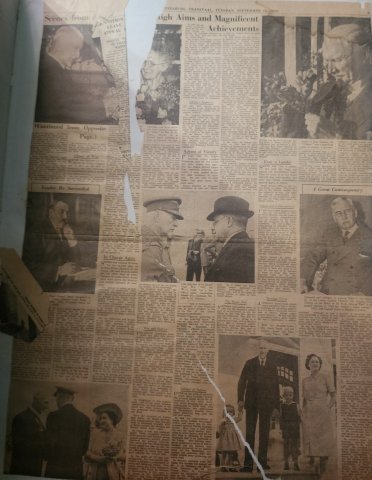
Scrapbook page 2: Scenes from / High Aims and Magnificent Achievements / The Royal Visit / Advent of Famine
Date(s)
- Tuesday 12 September 1950 (printed dateline) (Creation)
Level of description
Item
Extent and medium
1 scrapbook page
Context area
Repository
Content and structure area
Scope and content
Quality check: on 2 part(s) of this page with enough text, 67% of the words in the shorter of two independent model reads are confirmed word for word by the other read.
ANNESBURG, TRANSVAAL, TUESDAY, SEPTEMBER 12, 1950
Scenes from
LEAVE
APPEAL
(Continued from Opposite
Page.)
Onset of War
SMUTZ was Minister of Justice in the Union Cabinet. He gave all his time to research and study international politics to the exclusion of other matters.
Leader He Succeeded
SOUTH Africa's new leader, General Smuts, has been in public life for more than 40 years. He had been in public life for more than 40 years. He had been in public life for more than 40 years. He had been in public life for more than 40 years.
In Charge Again
SMUTZ was nearing 70 when he became Prime Minister of the Union. He had been in public life for more than 40 years and engaged in tasks which would have worn down the physical and mental strength of most men.
High Aims and Magnificent Achievements
In June, 1945, Smuts' name received urgent consideration as an alternative to Churchill. The Union Parliament had elected before the war and from the end of the war in 1939 was only 22 years old.
Advent of Victory
IN June, 1945, the Anglo-American forces advanced towards the end of the war came clearly into view. The last stages proved longer than expected but the Union's resources were sufficient to meet all demands from all sections of the people. After that, the South African Army was in a position to support its Allies.
In Charge Again
SMUTZ was nearing 70 when he became Prime Minister of the Union. He had been in public life for more than 40 years and engaged in tasks which would have worn down the physical and mental strength of most men.
The Royal Visit
A STRONG constitution seemed to be necessary in order to throw off the yoke of a hard-cooked politician, a combination of statesman and soldier who combined with his decision. Churchill was not only able to cope with the political mind in South Africa but also with the public mind.
Advent of Famine
CLOSE on the heels of universal peace came the famine. The primary causes lay in the overproduction of foodstuffs, severe droughts and the disruption of world trade. This disorganisation of Government controls everywhere was a result of the war which had ended.
In recognition of this achievement and of the great personal sacrifices made by the Union to the Allied war effort, General Smuts received Field Marshal Lord Allenby in London on 20th March as his guest at the Imperial Conference.
The Royal Visit
A STRONG constitution seemed to be necessary in order to throw off the yoke of a hard-cooked politician, a combination of statesman and soldier who combined with his decision. Churchill was not only able to cope with the political mind in South Africa but also with the public mind.
A Great Contemporary
Opponent and colleague of General Smuts is the political life of the Union, General Hertzog, who became Prime Minister on the defeat of the South African Party in 1933.
Scenes from
NATION
LEAVE
APPEAL
SEQUEL TO
OF CHAIR
NATIV
(Continued from Opposite
Page.)
Onset of War
Leader He Succeeded
NNESBURG, TR
igh Aims
Choosing a rose for his button-
hole from a bouquet presented
to "Ouma" by Mrs. M. M.
Cussen (Mayor) at an
informal family gathering at
Irene in February last year.
every subjects and some of their
more dangerous accomplices was
to create a supply organisation
for the army. A Directorate
General of Supplies was set up
under Dr. N. J. van der Bijl to
convert Union industry to war
production. The results were such
that when a South African Army
took the field in East Africa,
towards the end of 1940, it was
equipped almost entirely from the
Union's resources.
Volunteers came from all sec-
tions of the people. After Italy
entered the war in June, 1940,
the South African Army ex-
panded at a rate that seriously
taxed supply and organisation.
The Commander-in-Chief was
indisputable. His confidence in
Adven
IN June,
America
Normandy,
war came
The last at
than expect
nearly a 7
the Axis to
ruin. By
Japan had
same path.
South and
Conference
URG, TRANSVAAL, TUESDAY, SEPTEMBER 12, 1950
Aims and Magnificent Achievements
Nation's Approval
Advent of Victory
Ever a Leader
Ideals and Achievements
A Great Contemporary
represented the wish of
majority of the people.
Nearly four years later
general election was fought on
the war issue. To the new
House of Assembly came 209
members to support Smuts and
only 42 to oppose his policy. The
United Party won 89 seats,
giving it a majority of 28 over
all other parties. It was cal-
culated that 652,036 votes were
cast for the war policy and
287,128 against it.
In Charge Again
SMUTS was nearing 70 when,
for the second time, he
became Prime Minister of the
Union. He had been in public
life for more than 40 years,
engaged in tasks which would
have worn down the physical
and mental strength of most
men.
The Cabinet of which he took
command in September 1939,
cannot be described as a strong
one. There were numerous hos-
tile groups in the Union - some
openly pro-German, some anti-
British, and some rosely
isolationalist Afrikaaner. Sabotage
and subversive propaganda had
to be fought; and the things of
state for the war were deeply
misunderstood by large numbers
of people.
Yet the difficulties and strains
of his position seemed to endow
Smuts with increased driving
force. This was particularly so
when in the Defence Force,
which had lapsed in numbers and
efficiency. Hurried improvisation
was necessary.
The problem of maintaining in-
ternal security without spoiling
farm measures, which would
make in a section of the people,
the management of a Parliament
in which for the first four years
of the war he had not an over-
majority; the task of keeping
links with Allied Governments;
their and other responsibilities
made an overwhelming burden. In
addition to his duties as Prime
Minister, Smuts was Commander-
in-Chief of the Union's Forces on
land, in the air and at sea.
The task of putting the country
on a war footing was tackled with
characteristic energy. One of the
first necessities, after rounding up
the darkest days of the war rallied
the country to his leadership.
He rejected with scorn the
"peace" movement launched by
his opponents after the fall of
France. Instead, he despatched
the 1st South African Brigade to
reinforce small British forces
facing an Italian army on the
Kenya frontier. He flew to East
Africa to inspect the troops and
discuss plans for an offensive.
This was launched soon after-
wards with spectacular success.
He met Mr Anthony Eden, then
British Minister for War, and
General Sir Archibald Wavell at
Khartoum.
War and Politics
THE anti-war Opposition mean-
while had split into several
factions, following the resignation
of their leader, General Hertzog.
When Smuts next faced them in
Parliament he found them with-
out effective leadership. Their
protests against South African
troops fighting leveled "Southern
Africa" evoked no popular re-
sponse; and a "peace" petition
presented to Parliament was
countered by a larger one support-
ing Smuts's policy. By-elections,
which were beginning to accumu-
late, showed that the Govern-
ment was more than holding its
own.
In March General Smuts again
visited East Africa, and flew on
to Egypt. There he met Mr Eden,
General Wavell and Sir John Dill.
In April the capital of Abyssinia
was occupied, in a campaign in
which South Africans played a
brilliant part. The complete con-
quest of the Italian Colony was in
sight.
In recognition of this achieve-
ment, and of the great personal
contribution he had made to the
Allied war effort, General Smuts
was promoted Field-Marshal by
the King.
After the conquest of Italian
East Africa, the South Africans,
with reinforcements that brought
them to Divisional strength, went
to Egypt to meet the German and
Italian threat from Libya.
At home, a wise and moderate
policy, which recognized political
differences but took effective action
against subversive activity, greatly
improved the political situation.
One result was that Field-Marshal
Smuts again was able to visit the
troops in Egypt before the success-
ful offensive in which they took
part towards the end of 1941.
In the midst of its war pre-
occupations, the Government con-
tinued to advance a programme of
social and industrial reform. This
largely was on the Prime Minister's
initiative. The policy he outlined
at Bloemfontein in 1941 came to
be known as the "Bloemfontein
Charter," an there emerged the
Social
the dark da
World War
We's lead
nation's cam
minute able
with his H.
J.
vicks
the battlefield, t
1945 he won't
as the UN's
inaugural and
Nations Ordate
At this blar
was an outg
regarded their
of UNO as
illegalit afe
accordingly off
which commi
States to ethis
substance hi
accepted, and t
part the autha
prove to be one
portant docume
for mankind.
In 1946 Smuts
again this tim
Imperial Confer
ported Peace C
expectations we
as the Council of
ters was unable
basis of the pe
the conference w
ahead of a Pe
Indeed, internat
were heavily cha
picion.
Advent o
CLOSER on the b
peace came th
The primary cause
vations of war
were severe groun
organisation of re
disorganisation by
Government
where persisting
war had ended.
In 1946 the re
South Africa occa
severe, and Smuts
ernment declined st
favour. More tha
the war, the "black
ished as never befor
first time a ration
foodstuffs had to b
the Union. The
gency presented a s
tangles; and the
specially protected,
ment of the Ma
against the econom
might alter their
much food.
In Smuts's abse
Union the burden f
Mr. J. H. Hofmey
Prime Minister.
United Party in
against an Opposi
ended by the endin
time Coalition G
the dark days of the Second World War (1943) the W's leader has a few nation carrier-conversation minutes able lieutenant, Mr. with H. Hofmeyr. J. aids of Normandy. In the battlefield to San Francisco 1945 he won's delegate to the as the Uni of the United inaugurationisation. Nations Orkasteric gathering be At this handing figure. He was an outg draft constitution regarded though too dry and of UNO as document, and egalistic affared a preamble accordingly oited the member which communi imperatives. In States to ethics offering was substance hi'us he became in cepted, and 1/ of what loag art the authoif the most law rove to be one is ever written ortan; document or mankind. vas in Europe In 1946 Smuts (to attend an guith this time y and the ex- perial Conference, rence. These ed Peace Confe of realised. operations were nigh Minis the Council of For on the ra was unable to agree es for oaks of the peace treat? la- e conference to consider nos, sad of a Feare Confer ons land, international relati- re heavily charged with yon. Advent of Famine LOOR on the heels of universal peace came universal famine. primary causes lay in the de- tations of war; other causes severe droughts and the dis- anisation of world trade. This organisation was accentuated Government controls every- re persisting long after the had ended. 1948 the repercussions in h Africa became increasingly ve, and Smuts and his Gov- ment declined sharply in public or. More than a year after war, the "black market" flour- as never before; and for the times a rationing of certain stuffs had to be instituted in Union. The housing emer- presented a series of official les; and the farmers were ally protected, in an amend- of the Marketing Act. at the economic risks that attend their producing too food. Smuts's absences from the the burden fell mainly on J. H. Hofmeyr as Acting Minister. He led the Party in Parliament an Opposition stur or the ending os the war. Coalition Colonel Saland taine As a whole the South African people approved of Smuts's presentation of the Union's case; and in the result he gained stature at home by this rebuff abroad. The Royal Visit ANOTHER outstanding event in 1946 was His Majesty's accept- ance of an invitation to visit the Union in 1947 with Her Majests and the Princesses. This was the first visit to South Africa by a reigning sovereign; and in Smuts's life it had a romantic aspect. Forty-five years had passed since the South African War, and as Prime Minister of the Union he welcomed not the King of Great Personal Traits A STRONG constitution, sound sleep anywhere and a facility in throwing off harassing matters in a few hours' relaxation enabled him to endure almost super- human pressure. He was not only a statesman and a party leader. He was a philosopher, a soldier With his daughter-in-law, Mrs. Jannie Smuts, and her children, Joanne and Mary Anne, March, 1948. Opponent and colleague of General Smuts in the political lite of the Union, General Hertzog, who became Prime Minister on the defeat of the South African Party in the general election of 1924 but formed a fusion ministry in 1933, with General Smuts as Minister of Justice. confident. Although he had a wide knowledge of history, he was inclined, like Dean Swift, to look upon the past "as so much dirty linen, and to think chiefly of the present and future. He was an opportunist to the extent that he realised conditions always were changing, and that new outlooks and methods were necessary He was a student and services in speaking out others perforce were silent. A notable example w onedcast from London Co 30th Union Day, soon after in Germany. He politely ins to both Russia and the stated that the British Co wealth has a great future he warned the world leaving the German rail- mofestation of despair. In all this he rendered set may be regarded greatest service to his country. For he gave the prestige in the counsels kind to which is had to apart from himself. Many induced all thinking South cans to examine the work, and in thus working against a rooted tendency vindication and channelled both sections of the White latins-he won the interest country's soul. An Authentic F OF Smuts as some- thinker this is not for a final evaluation man in politics who was and present for his chara and philosophy now be risks By many he regarded as a rather than as a domi thinker. Many opposed ality. But honest mind he did reasons, sity enlightenment all he As human tendencies to themselves, more ins ractor. The mean way rightness, soft; a man of and action always is-w to his government, be w and proper to say that He won is authentic He received many honours, jewelled ve- lorshipship of St. And every the freedom great rites, the French Rural Honors degree greatest diverseness dency of the British for the Admewever, the attention of people everything a Pack hains the Conquest Raiment, the Order is Re the benefits of all ign men and women, the cognition of service gised of his
Conditions of access and use area
Conditions governing access
Survey photographs taken 19 November 2026. Published with the permission of Smuts House Museum (General Smuts Foundation).
Allied materials area
Existence and location of originals
Smuts House Museum, Doornkloof, Irene
Notes area
Access points
Subject access points
- Death of General J.C. Smuts at Doornkloof
Name access points
Description control area
Accession area
Digital object metadata
Master file
Filename
master_smuts-funeral-scrapbook-p02.jpg
Media type
Image
MIME type
image/jpeg
Filesize
450.3 KB
Checksum
798fdc9ce765f88330c28991936932e7Reference copy
Filename
reference_smuts-funeral-scrapbook-p02.jpg
MIME type
image/jpeg
Filesize
37.7 KB
Thumbnail copy
MIME type
image/jpeg
Filesize
2.8 KB